Showing posts with label lessons learned. Show all posts

Saturday, June 28, 2014

Slowing down at work

It's been a long old week and next week will feel longer - lots going on at work, which is a mixed blessing. On the one hand it's interesting work, and I'm really enjoying the sense that I'm increasingly competent and increasingly confident in what I do. On the other hand, long hours mean tired Nickie with no time for housework, crafting, or quality time with friends and family.

A few months ago it got very busy and I started showing early signs of burnout, so I've been working on several tips and tricks recently to try to manage the stress so it doesn't have such an impact on my health. I thought I'd share a few tips for slowing down in a busy work life here with you:

1. Tortoise not hare.

When you rush because you're busy, you make mistakes and have to go back and correct them. (Or at least I find this). This is stress-making for you and your colleagues. When it's super busy, it's even more important to take an extra moment just to check you haven't made any silly mistakes or typos. I'm finding that by telling colleagues I'd like a little more time to get it right and then delivering a better document, they are more relaxed with me about deadlines because they know they can rely on me. I know the work is piled high but better to do it once well than several times badly.

2. Avoid stimulants.


Coffee and sugar make me jittery and I find myself navigating peaks and troughs of energy. I'm finding that limiting the coffee and drinking green tea and water really helps me maintain a steady focus and keep a good pace of work. Eat fruit, raw vegetables and nuts as snacks if you get hungry, and avoid a heavy lunch. (Some people at my work eat pizza or lasagna every day - I have no idea how they avoid falling asleep afterwards.)

3. Tune out the stress.

Offices are noisy places, especially open plan offices. People are talking on the phone, having impromptu team meetings, receiving text messages and tap-tap-tapping on keyboards. Block it out. Bring a pair of headphones and listen to something online or on a music player if you have one. Music is good - programmes like deezer or spotify allow you to stream music free. Radio is also possible - BBC radio is available anywhere in the world for free. Personally, I'm preferring the many youtube videos offering 10 hours of the sea washing up and down a beach, of crickets or birdsong, or meditational noises like wind chimes. I can almost feel my heart slow down as I breath more deeply.

Wednesday, June 18, 2014

My missing month: Lessons learned during my blog absence

So. What was I up to during the last month? You won't be surprised to hear that I've been working a lot, and also a fair bit of travel (some work, some play), which has meant several weeks when I've only been at home for a few nights. From this month, some things really stand out.

1. I love my minimalistic wardrobe.

When you're packing for a six-day trip which encompasses a business trip somewhere very hot and sunny with a personal trip somewhere probably cold and grey (the UK), and through an administrative error it transpires that you don't have any luggage booked in the hold for the flights, what is your reaction? Sheer panic? Thanks to Project 333, I managed to pack with only one fairly modest carry-on bag and with no stress at all. In fact, I didn't wear all the 'combinations' I'd allowed for because the weather in the UK was unexpectedly nice. 


This caused some humourous moments when we arrived at the business trip, me with my tiny overnight bag for six days, and everyone else with HUGE GREAT BIG SUITCASES. (Most of the guys had bigger bags than the girls, interestingly). I quite enjoyed the incredulity it prompted.

2. You'd be surprised at what Muggles like us can fix.

We're all about the repairing and mending in the simple living club. We sew buttons on, we mend tears, we might repurpose or upcycle a damaged table or stained sheet, and it's not strange to see weird and wonderful receptacles used as planting containers. We'll paint walls and put up shelves, but some things we generally think should be left to the professionals - in my book, plumbing and electricity. Anything that could kill you or damage the structure of the building is a bit of a no-go zone.

Not so for my boyfriend. Water has been constantly running into our toilet bowl for some time now. It's annoying and it's an expensive waste of water. We did have a look in the tank and thought it was build up around the outlet valve causing it not to shut properly, and started putting bicarb and vinegar down it regularly, with no success. This weekend my boyfriend amazed me by working his way round the inside of our toilet flush mechanism to identify the problem. After removing and taking apart the inlet valve, he found the problem - a tiny rubber diaphragm (about 3cm across) was degraded and this was causing a constant drip-drip of water into the tank, which was then flowing into the toilet bowl through the overflow mechanism. 

We took the dodgy diaphragm to the DIY shop, found a replacement, put the valve back together, and voila. Toilet fixed, at a grand cost of €6. I am supremely impressed, and convinced that provided you turn off water and electricity supplies at the mains/entry point to the flat before you start poking your fingers in, we could probably fix more things than we realise.

3. Gardening needs more than watering, it needs planning and execution.


During my busy period, I have managed to keep watering the surviving plants every few days. Most small seedlings have died because I didn't have anything to plant them out or up into, but my beetroot looked like a small jungle. I was starting to worry I would get sick of beetroot, that I would run out jars to pickle it all.

Then I picked some to roast for lunch. This is what I got:


I'm a gardening noob here and this is my first attempt at beetroot. I'm guessing that this is the result of (a) not thinning the beetroot seedlings and (b) letting the soil get too dry at some point and so become more dense/caked. (If anyone has any suggestions, please let me know!)

It's very clear that my loose plan wasn't much of a plan at all, and I need to have something like a rough schedule and a clear idea of what will be planted where and when before I touch any seeds. I'm still on the hunt for cheap things I can use to plant on the balcony because I continue to refuse to fork out €10 for a low-grade plastic pot in the gardening centre. I feel like it kind of defeats the point of the exercise.


So that's what I've been thinking. How about you? Any standout moments from the last month?

Monday, February 17, 2014

Simplicity in the city

I am fairly sure I am not alone in the yearning for a little more space to experiment with simple living. Probably one of the most basic tenets is trying to raise your own food - plant and animal. Whether you want to be sure that your food has been organically, ethically and locally raised, or whether you are just intrigued to learn more about where food comes from, the difference between eggs from different birds and breeds and the commercially unknown variations on 'standard' fruit and veg (golden beetroot, yellow raspberries, purple carrots and so on), I think many of us want to explore this arena - certainly I do.

However, this takes space. Yes, you can grow food in pots on balconies, and yes apparently you can even raise quail in a (largeish) balcony, but you certainly can't get a goat or a milk cow to supply your home dairy, or have a large enough apple harvest to fill your pies through the winter. And moreover, I certainly would not feel comfortable raising quail or any kind of animal on a balcony because even if they only need something like 1-2 square feet per bird, it would still feel wrong not to house them somewhere they can peck at grass and bugs and suchlike.

So what do we do? Well, we can certainly live vicariously through other people's farming endeavours. I am personally really enjoying Kate's tour of Purple Pear Farm for International Year of Family Farming. We can read up and educate ourselves on how to plant a vegetable garden and how to manage livestock, or begin practicing some of the skills that might come in useful, such as combing and spinning a fleece, or making yoghurt and cheese.

However, far more useful and far more satisfying for living a simpler life now is to focus on those things that are as easy - or in some cases even easier - in an urban environment.

 
(1) Transport

Ever hear people talk about the challenge of becoming a 'one-car family'? It's not an uncommon phrase on some simple living blogs and podcasts (particularly in the USA, I think). It sounds weird to me. I don't know any family with two cars. We don't even have one. Why would we need one? Why spend money to sit in long traffic jams and then spend ages trying to find a parking space? We live a twenty-minute walk or less from parks, metro stations, supermarkets, bars, restaurants, farmers markets, and both our work places. We can walk to the city centre in 40 minutes, or take the metro and be there in 25. So take advantage of public transport, bike lanes and your own two feet - and think smugly of all the CO2 and all the hard-earned money that you are not wasting on car use.


(2) Community

You might just have noticed that population density is rather higher in cities than more rural areas. That means a whole lot more people to share things with. Whether farmers' markets or knitting groups, cookery courses or opportunities for political engagement, there's probably far more in your city than outside. Find something that feels right for you in your area and get involved, even if just once a month.


(3) Small living

If you live in a city, the chances are pretty high that you live in an appartment. Space will be limited, and the cost of upgrading to a larger home will probably be discombobulatingly high. Think about using the space you have now more effectively, try to reduce the amount of stuff you have and streamline the time, effort and money it costs you to maintain your home. Think about how your routines support the life you want to have, and consider making your own green cleaners. You might even open up some space for trying new things like stockpiling and preserving.

 
(4) Simplifying your diet

You may not be able to grow your own - yet - but you can certainly work on how you will use them when you do. Start meal planning, shopping on a budget, and exploring local farmers' markets where you can try lesser known vegetables. Have a go at preserving - make strawberry jam when it's in season and cheap, or pickle beetroot. Learn to bake bread or make yoghurt or brew beer. Whatever you do, focus on things you like and enjoy, and start slowly.


Rhonda Hetzel over at Down to Earth encourages us to 'bloom where we are planted' and it is so true that we feel dissatisfied when we focus on what we can't do, but enriched when we focus on what we can. Start here, now, where you are.

Tuesday, January 14, 2014

A friend and five lessons learned

This post is addressed to, and inspired by, a very dear friend of mine. She is a kind, thoughtful, intelligent and creative person, who gives far more of herself than anyone has any right to ask, and she has consistently been a far better friend to me than I have been to her.

This lovely friend of mine is grappling with a major personal challenge. Owing to a number of factors which I won’t go into, but which are absolutely and in no way her fault, she is caught in a tangled web of self doubt, self criticism and perhaps even self hatred. She knows she needs to get out of this web, but that is a lot easier said than done. I can tell her how wonderful a person she is until pigs fly, but this is not a journey I can make for her, it is entirely hers. 

While she is in an unusually difficult position, I think to some extent we all want to change ourselves and our lives in some ways. Break bad habits, break bad relationships, do the thousand and one things we always dream of doing but never really believe we can. We sort of half believe that, in fact, we could get up at 5am and run 10km and come home, renovate the bathroom, still be at work by 8 etc. Whether it’s a sport thing (I’ll get fit), a diet thing (I’ll eat healthier), a work thing (I’ll be more dedicated), a craft thing (I’ll finish all my projects), a homemaking thing (I’ll clean the whole house top to bottom)… 

We’re all caught between thinking we can do everything and thinking we can’t do anything, so we end up doing nothing and feeling like failures. At least speaking for myself, I have generally found that I think to myself that I should go for a long run and get some exercise, but feel discouraged or defeated before I even put on my shoes and end up rewatching an old tv programme on my laptop eating crisps or chocolate. And it seems normal when you’re there, even though from the outside it’s easy to suggest that maybe going for a walk would be a good halfway point. 

What I’ve found is working for me (at least at the moment, and life is always a three-steps-forward-two-steps-back business for me) is setting infinitesimally tiny goals. My goal today – the entire day – is to take the rubbish out. My goal for today is to write a letter. My goal for today is to not eat the croissants provided at work. (That one always fails). It’s easier to set a goal to do something than not do something (easier to eat a piece of fruit than not eat a biscuit, even if eating the fruit then helps me not eat the biscuit…) 

I don’t want to tell my friend that I know how she can ‘fix’ the tangled mess she finds herself in. What works for me won’t necessarily work for her. And I do know how effing frustrating it is for people to roll out their tips and tricks and make it sound so easy, when I know it isn’t. 

But this blog is really about a journey to try to shape a life more deliberately and intentionally, and there are a number of things that have helped me with my journey so far. I haven’t really seen much discussion of self-discipline on simple living blogs, but I think it’s the foundation of my simple living journey in many ways because the ideas, projects, crafts that are here would still all be in my head without it. It’s something I’m still working on, every day, so this post is as much a reminder to myself as a very long-winded and beating-about-the-bush way of saying to my friend: I can’t fix it, but maybe some of this will help?

1. Set small, easy goals
Really, really, really tiny. Today I will go for a two-minute walk in my lunchbreak. Today I will eat an apple. It doesn’t feel daunting. Try to keep the goals positive – I will – rather than negative – I won’t. Plan when you will fit it into your day, ideally with a cue (I will eat an apple when I get home from work/with my lunch/when I finish checking my emails). Minimise the effort involved – make sure you don’t need to go out to buy something. If you need something, prepare it in advance and take it with you. Make sure it doesn't depend on other people.

2. Choose the path of least temptation 
My office is essentially built like a square with the middle missing. From the kitchen to my desk, there are two possible routes. When I’ve made a cup of tea, I tell you, it’s a hell of a lot easier to decide to walk back along the route that doesn’t have a biscuit tin than it is to walk past the biscuit tin without taking a biscuit. Try to build your day to avoid temptation. Always stop in at the bakery? Walk a different route, or along the other side of the road. Always end up going straight home instead of to the swimming pool? Take a bus that doesn’t stop near your house.

3. Be your own cheerleader 
What mental messages are you sending yourself? Even if you tell yourself that you can, is there still a negative voice saying ‘you won’t do it anyway’? Squash that voice. Go on. Shove it out the door. And turn the lock. Or if you can’t, drown it out. While you are doing your small challenge, or preparing to do it, talk to yourself – or sing, or recite, whatever helps. When I go out for a run (and run isn’t quite accurate, it’s lots of walking with intermittent jogging), I am constantly saying (more like shouting) to myself: You’re nearly halfway! You’re already nearly halfway! You can do this! Think how good it will feel when you finish! Think how wonderful it will feel all the rest of the day, the rest of the week! You’re making yourself fitter and stronger! You’re building your willpower and your self-discipline every second that you keep going! Look, you’re still going! You can do this! (etc…) And I’m finding that very gradually the voice that says ‘wouldn’t you rather be watching Downton Abbey with a slice of cake?’ is getting quieter and easier to ignore. 

4. Feel pride in even the smallest achievement 
Even if your goal was to eat an apple, feel good when you do it. Setting a goal and delivering on it should feel good, regardless of the goal. And the positive feedback loop helps motivate the next goal. Even if that is only eating a pear. Treat yourself (in some way that doesn’t undo the progress you’ve made). One of my treats is to take a long soak in a hot lavender bath with one of my favourite books. If you plan on repeating or building on your small goal, track it. An excel spreadsheet, a pretty notebook, a scrap of paper pinned to the wall – so you can look at it and think: Yes! I did that every day this week! 

5. Forgive yourself and keep going 
If – WHEN – you slip up, because we all do, don’t beat yourself up. Don’t feel bad. Don’t let one slip ruin a good week. Remind yourself that to fall, dust yourself off and face up once again to the challenge is something that has always been difficult, and is a theme handled in many classic stories. Remember this example from The Horse and his Boy? 
“In other words," it continued, "you can't ride. That's a drawback. I'll have to teach you as we go along. If you can't ride, can you fall?"

"I suppose anyone can fall," said Shasta.

"I mean can you fall and get up again without crying and mount again and fall again and yet not be afraid of falling?"

Sunday, October 13, 2013

That having been said...

I love ablative absolutes, don't you?

So no sooner had I finally blogged about the soul-destroying pile of crap beside my bed which I was climbing over every evening than something changed. We were watching a tv programme today about a compulsive hoarder, and my boyfriend gave me A Look. I protested that I was not a hoarder but as the programme continued, I found it harder to argue this point. I also find it hard to throw things away, even broken and unusable things, because I feel they have an inherent value and deserve a better fate. I hoard very little now, but the idea that this practice is just the tip of a potentially life-damaging iceberg is rather terrifying.

I'm wondering whether I need to come to terms with the idea that, in the process of simplifying my life, I just have to accept that some of the things I have accumulated to this point cannot be a part of my journey going forward. Eventually I will reach a point where I don't have any 'superfluous' clothes which I am torn between keeping, donating and cutting up for crafts. I will reach a point where every used item of clothing can be 'processed' for rags and reusable fabric. At the moment, I just have too much. An example: I have some off-cuts from the curtain lining. It's too small to be used for more curtains, and even if it were, I have no more lined curtains to make. I've been keeping them with the idea of using them as backing for a crocheted rag rug or something like that. But I also have several lengths of beautiful new fabric just waiting to be used, some Vogue patterns waiting to bring a new dress to life, and a wardrobe desperately in need of rejuvenating. Why don't I give up on odds of blackout lining and focus instead on these other projects?

I'm also realising that by perhaps overcomplicating my project list - by intending to do everything from scratch from the beginning - I'm disincentivising the smaller projects that I could more realistically achieve with the time available to me after my long days, and the rule I have somehow developed of throwing nothing away is more hindering than helping my creativity. There's nothing wrong with small steps - in fact, I am reminded of my colleague's reminder that when starting a new job, you need the humility to accept that you will make mistakes during the learning process, and that you have to give yourself time.


So today the space by my bed is clear. A lot of the mess has just been moved around - the clothes back to the wardrobe, the spare fabric into a box - but I've put some things on a 'to donate' pile. (Now I just need the steel resolve and ruthlessness to actually donate them, instead of rescuing things.)

Either way, I think I will sleep better tonight for having a less stuff to navigate.

Saturday, October 12, 2013

Confessions

The blogs I most enjoy are not the ones that depict a picture-perfect life - much as I enjoy the fantasy of that, I know that this is just not possible for most (all) of us. So it follows that, much as I would love to turn this blog into a catalogue of the best moments, a collection of pictures of tidy rooms and fresh ironing, of homemade bread and pots of tea, I feel compelled to honesty. Today is a day for confessions.

Confession the First: The Pile

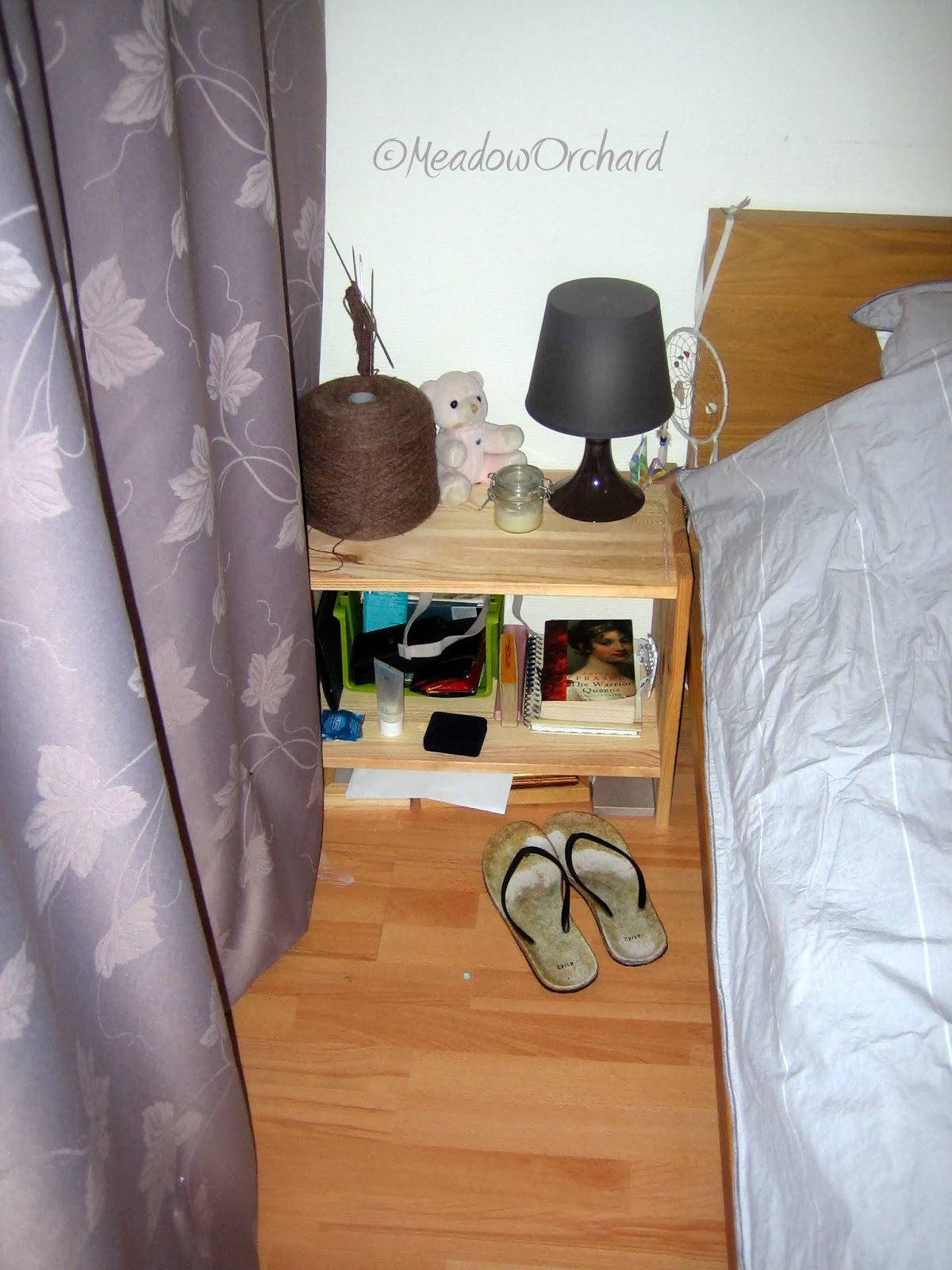
It has to be capitalised. It's not a pile. Oh no. It's The Pile. This is a picture of the area beside my bed:


It consists of scraps of fabric from old projects, balls of wool, the swatch for a new pair of socks I'm planning, letters that need replying to, documents which need filing, books, handcreams, jewellery, a bag of essential oils, my spindle and wool for spinning, a spare towel, my slippers, my flip-flops, and lengths of fabric ready to be used, as well as old clothes that need mending or that are past mending and are ready for the rag bag.

To be brutally honest, the Pile was a helluva lot more impressive two weeks ago. I've removed a significant number of items in the rediscovered craftiness of the last two weeks. Please also note that the pile extends under the bed as well.

My challenge is pretty much the same one as always - being constantly torn between on the one hand a desire to get rid of surplus possessions, to simplify everything from my wardrobe to my craft cupboard down to practical, beautiful essentials which contribute towards my goal of living a purposeful, efficient yet meaningful and uplifting life - and on the other hand, a reluctance to throw things away which still could have function, a desire to repurpose, reuse, adapt, personalise. Which means I get as far as taking old clothes out of the wardrobe, or keeping fabric scraps out of the bin, but not as far as actually DOING anything productive with them!

I have spent most of my evenings for the last week unpicking the seams of four items of clothing which were so stained, worn, torn and moth-eaten (repsectively) that I had resolved to finally convert them into panels for my next next next project, a patchwork quilt. (Never do things by halves. My first patchwork quilt will be super-king sized). I am finally making progress with some of the pile - but I am stumped by the 'superfluous' but still functional clothes. Can I bring myself to cut up perfectly serviceable clothes? My moral dilemma of the week.

Confession the Second: Bloody beeswax


One of the crafty projects that has been on my list for sometime was making homemade candles. I've watched Kirsty Allsop do it, and it seemed really basic - melt wax, add essential oils for scent, pour wax into containers with wick inserted. Allow to cool. It seemed so easy.

At first, it was rather hypnotic - I was moved to take a photo of the melting beeswax, which also smelled lovely. But then I came rather unstuck with pouring the wax - the wicks I had bought from the craft shop sort of floated around. My boyfriend came to the rescue, improvising with a teaspoon and a couple of toothpicks, and the wicks were in place. I thought the worst was over - BUT NO!

Oh woe, woe and thrice woe. For I have STILL not got the bloody beeswax off the plastic measuring jug I used for pouring the wax. I have tried freezing it, which is supposed to make the wax harden and crack off. I have tried soaking and scrubbing it in boiling water, alcohol, baking soda and washing up liquid, individually and in combination. The jug sits on the side in the kitchen, looking sorrowfully at me, and reminding me to give it a hopeful bath every time I do the washing up. Each day, it becomes infinitessimally cleaner but it's definitely not wax-free yet.

Gentle readers, take heed - do not put melted beeswax in an implement you intend to use for cooking. Have a beeswax jug in the corner of some cupboard which can live with a crust of wax.

I think that's enough honesty for today! I'm off to ignore the pile of projects and do some knitting.

Thursday, May 17, 2012

Overambition?

I know it's not only me - I read several blogs about people doing much the same thing. Simple living, thriftiness, the new home front - call it what you want, it essentially comes down to trying to buy less and make more, to do things for yourself rather than paying someone else to do it for you.

It's easy to feel disheartened by the number of things not yet achieved. I look around and see the housework not done, see the things I still buy instead of making, things like bread and soap which are among the first things that you start making for yourself, as well as cleansers and make up and toothpaste, containing chemicals I would rather eliminate.

Friday, August 19, 2011

Looking for alternatives

I'm actually feeling a little bit annoyed with myself - because yesterday, I had the opportunity to challenge myself to find an alternative to muffin cases. After all, there were cupcakes before cupcake cases (I presume, anyway!) When a friend made several very practical and frugal suggestions, including one I could have implemented without making any additional purchases, I felt a little bit ashamed that I didn't think of them. I guess I still have a way to go in thinking outside the box.

In many cases, this comes down to focusing on the result you want to achieve - preventing the cakes from sticking to the tray - rather than the tools the recipe tells you to use.

Well, thanks to my friend's suggestion, I will look carefully at muffin cases and at her suggested alternatives, and make a selection that balances practicality with frugality. I think I may go for baking parchment, which I can cut into squares and use. I think this will be more cost-effective than cases.

One good thing did come out of my search - I didn't find cases last night, but I did find affordable gelatine sheets, which I have seen in several recipes but been unable to find to date.

Monday, May 3, 2010

Craft Workshops

Hello! I am still alive, you can breathe a huge sigh of relief. Life caught up with me, so I do in fact have a long list of blog posts I'd like to make on various topics, some of which are looooong overdue. Like this one.

As part of my interest in the journeys that our possessions take from the extraction or production of the raw materials through to the disposal of the used product, I am just a little bit interested in craft. I work with wool, and I am interested in all of the stages of the process from fleece to jumper. When I started working with Sunbeams, a Brussels-based charity promoting ecological issues in the English-speaking expatriate community here, I mentioned my interest in craft, and eventually we organised a Christmas Craft workshop.

It was a really good fun afternoon. There were several different activities going on, and the group of children moved naturally and easily from one to another as each was completed. Most of these involved using items that would normally end up in the bin - the insides of toilet paper rolls, scrap paper, and especially Christmas wrapping paper. My own contribution was introducing them to crochet, making creations vaguely resembling snowflakes. I did find that teaching crochet to that age group was rather tricky, as you can't do any of the fun stuff, but that's just something I need to work on.

I really enjoyed learning to make, for example, plaited heart-shaped bags to hang from the tree, using old wrapping paper. And I loved sharing my passion with a group of little people, who were all really proud of their creations. I think what made the craft afternoon so successful was that there was a range of different activities, so that the pressure didn't fall on any single person to keep people interested for the whole afternoon, and that it had a fairly specific focus. The range of activities also meant that people could arrive and leave whenever suited them, and do as many or as few projects as they wanted to, as quickly or as thoroughly as they liked.

I have attempted to get a craft workshop focused on crochet up and running, but I think the brief has been too vague and I haven't reached my target audience very effectively. Looking back at the success of this workshop, I think it would be advisable to choose a specific brief and bring together people interested in different crafts for a similar afternoon. Hmmm... It's a shame I missed the boat for Easter, but perhaps a Midsummer festival theme would work. Feel free to contribute suggestions.

Friday, January 15, 2010

On feet, and the worship thereof

So half an hour ago, the world was a terrible place. Oh woe, cried I, woe and thrice woe! I was exhausted, having spent three times as long as normal coming home from school because I had to skate up an iced-over footpath for several klicks. This meant my afternoon was effectively non-existent, and I only had time to go to a cash point, discover that my account has been blocked (AGAIN), and then get to the bank 3 minutes after closing. And let's not even mention the housemates (male) who apparently think that the dishwasher is loaded and unloaded by a pixie who lives in the still-not-replaced-lightbulb in the kitchen. (Whoops - too late!)

But then - ah, then! - I washed my feet. It's such a small thing, but somehow washing your feet in soap and hot water, massaging in some scavenged remnants of body lotion and following this with a newly clean pair of socks makes the world brighter. Suddenly, I'm drinking a cup of tea and remembering all the good things that happened today: the brilliant lesson with the 4th before lunch, signing on to a distance-learning course on the history of the English Country House, and (weirdly) waking up BEFORE my alarm clock went off this morning. (Does anyone else love doing that? I just hate the jolting-awake-panic-what-is-being-killed reaction I get when the alarm goes off. I feel it is the legacy of early morning fire drills/alarms at boarding school.)

The contents of my shopping basket today: bread, milk, two tomatoes and a cabbage. I won't tell you how excited I was at how much cabbage you can get for €1,49.

Thursday, October 29, 2009

Adventures in Container Gardening - Episode 2

Welcome to my second month of green-fingered-ness. Stage one consisted of buying a tired-looking basil plant in October from a local market stall, planting it in soil nicked from my landlord's garden, and then complaining vocally when aphids quickly installed themselves. The basil was then potted up into a bigger pot with more soil, and the smaller pot used for a new parsley plant from the supermarket. I am still squishing aphids against the window pane every day, and close inspection of the soil surface shows various kinds of small crawling things as well as several different types of mould. Not good. In desperation I have watered both plants heavily with an infusion of garlic. I'm not sure that this will help, but it made me feel better. (Ditto hissing 'Die, aphids, die!')

Lessons learned: (1) don't buy plants from a stall to make sure they don't already have insect infestations; (2) use potting compost rather than soil full of living things unused to life in a pot on my windowsill; (3) wash out pots which have had infestations in before re-use.

Thus, stage 2. I have planted some daffodil and snowdrop bulbs in two pots with proper potting compost. (At least, I think it's potting compost. My Dutch isn't so hot, and my French dictionary was rather limited.) One is in my room (away from the aphids!), and the other is outside, so I can compare their performance! We shall see what happens next.

Stay tuned for Episode 3: Growing Cress In Cotton Wool Because I'm An Actual, Genuine Beginner.

LinkWithin

Related Posts Plugin for WordPress, Blogger...