Showing posts with label thoughts. Show all posts

Thursday, April 17, 2014

Not the to-do list, or past and future challenges

We all have a to do list. I don't know about you, but mine is epic, vague, scattered across my computer, my phone and my memory, and nothing ever gets done. This is something I do intend to address.


However, today's post is not about the to do list, but the want to try list. I don't know if this happens to other people who start to build a more deliberate, individually crafted life, but the list of things I want to try keeps getting longer and longer and longer. I really want to render lard. Why? I don't use lard in anything, but maybe I could or should. And it's another skill, a historical one linking me with generations past, and one which would come in very handy should we ever raise and butcher our own animals (in another lifetime). Plus it looks so white and fluffy in blog posts. Want.

It's not a ripple when you drop a pebble in a pond - smooth, even circles gradually spreading. The process is more akin to simulations of how pandemic diseases spread (there's an example here if you don't know what I'm talking about). One dot glows. Then several close by. These fade as glowing dots appear, covering ground but seemingly hapharzadly, faster in some directions than others. It always looks a very wild kind of spread, unlike the orderliness of the ripples. (Hope I haven't freaked anyone out with the pandemic simulation!)


That's how simple living is evolving for me. Not a steady, orderly, progressive interest, but surges of interest in certain areas, drawing me into related fields, before another surge draws my attention elsewhere but the prior interest draws me back and soon, before I know where I am, I've covered the globe. 

Yoghurt making leads to cheese making and sourdough and beer and fermented foods. Homemade beauty proucts lead to homemade cleaning products, no-poo and growing my hair out, which leads me to begin to develop confidence in my own unconventional fashion choices prompting me to try Project 333 and ultimately set out to customise and handmake my wardrobe. Setting out to grow a few herbs introduces me to permaculture and soon I've put my name on an allotment waiting list and started looking into heirloom seeds, green manures and polytunnels. Now I find myself reading about rendering lard, building a garden smoker to smoke bacon at home, and goats' milk vs cows' milk.


I'm just taking a moment to step and think 'woah!' It's great that I've read loads on keeping chickens and am already aware that, for example, chickens are not naturally vegetarian, they like taking dust baths, they need grit in their diet and fresh eggs do not need refridgerating. However, given that keeping chickens is a long way off, maybe I should focus on things I can do now? So I can add to the progress I've made which, when I get caught up chatting with a colleague, seems to be rather a lot by 'normal Western life' standards. To be entirely honest with myself, reading about chicken-keeping is another form of escapism, a distraction from the life I'm trying to build here, today, and which requires me to step away from the computer screen.

It's very easy to get so caught up in the idea of the simple life that we put less energy into actually living it. Perhaps it's better to log off and just be present here.

Saturday, March 8, 2014

Permaculture in pots

When I bought my first ever batch of vegetable seeds, I hadn't put any thought into designing my balcony garden. My focus was on reducing my epic wishlist to something a little more manageable.

However, since my seeds have arrived, I have started putting a little more thought into how and where I am going to plant them, and this has led me to think about the design of my little corner slightly differently.

I am not very familiar with the principles of permaculture but I have generally associated them with rather larger-scale enterprises than mine. Moreover, my record with plants is not great - what is the opposite of green-fingered? - and I'd rather start small and build up, so embracing sophisticated new systems seemed just another complication.

However, I've been doing a little reading and a little browsing and I'm intrigued by the permaculture design priciples, and by some of the examples of applying them to even a single planted pot (Exhibit A). It is most definitely possible to encorporate at least some - if not all - of these in a balcony garden. I've done a little musing and a little research, and slowly my end-goal is taking shape, along with a clear set of slow and simple stages to take me from here to there.

One of the things I am particularly excited about including is biodiversity. At first I thought that there could not be any wildlife up here, several stories up in a built-up area. But it seems that insects can cover a wide surface area, there are several parks within a few km of my flat and I know of at least one bee hive within bee-flying range, so my flat could definitely attract bees if it had the right plants. While soil in pots will surely never be as diverse as that in the ground, there's no reason I can't make my little balcony a wayside inn for insects travelling between green spaces.

I already had some bee-friendly plants in my list - lavender being the best example - but I thought I should maybe think about improving my balcony's appeal to wildlife.

One of the principles of permaculture is to create a yield. At first glance, that means a crop such as beetroot or radishes, but the more I think about this, the more different kinds of 'yield' I am identifying. There's the fun of this whole adventure, experimenting with plants I have never tried before. There's the development of skills to care for and manage a range of plants. There's the improved aesthetic of my little outdoor corner, something I will definitely appreciate on warm weekends. And why can't flowers be a yield or a crop just by themselves? Whether enjoyed outdoors, cut for a vase or for a gift, or even eaten, there are clearly many ways to benefit from growing flowers.

That's me convinced. I've put in another seed order for a few bee-friendly flowers, favouring those which are edible in some way (homegrown sunflower seeds, anyone?) and trying to include a range of plants of different heights - some bushier, some tall, some ground-cover.

By planting mixtures of flowers, herbs and vegetables together, I will be able to create tiny little modules of biodiversity. I hope to add some sort of improved birdbath as well (still mulling on the best way to do this).

I think that's definitely taking on enough for the first year, although the temptation to keep adding another plant or concept here and there is very tempting. There are several steps - such as growing heirloom plants and saving seeds, or making my own compost from kitchen scraps - that I definitely want to try and will make the whole endeavour more cyclical (and also cheaper in the long-run) but I expect this year will be enough of a challenge as it is.

In the meantime, though, I've had a go at my design for the 'end-point' (or at least an interim point!) and I thought I'd share it with you.

 
My apologies for the shite drawing - although I hope at least you can tell which are the sunflowers - but I think you get the idea of using height, both the height in the space and the height of plants. There's a minarette apple tree to the right, and climbing plants - perhaps peas and honeysuckle - on the trellis and wire strung either side of the concrete pillar (which is otherwise just a block to sunlight). There's a flat bit on the right of the apple tree pot which is supposed to be a shallow pool of water tucked in between some bee-attracting plants. This is obviously a long way off, and there's more balcony I haven't tried to capture, but on the whole I'm very pleased with what I've mocked up. This is just the beginning of my permaculture design journey, after all!

(By the way, it's only just occurred to me that learning about permaculture principles and practicing them by applying them to my balcony is also another 'yield' from this exercise - as is my growing enthusiasm!)

Tuesday, February 18, 2014

Washing up: A philosophical meander

Today I was going to share a bit of a rant, as the demands of my job have been rather high recently, but I decided that was too negative and I'd rather focus on a slightly more positive aspect.


Do you have a focal point, a part of your life or home where you see the progress you have made and (in your mind's eye) the changes you still want to make? This is mine:


It's the window to the balcony, next to the kitchen sink. This is the window I gaze through as I dry the washing up every day. In the mornings, I get my first glimpse of the sun welcoming me to the tasks of my day. On clear evenings, I watch the full moon loom large, asking silent questions without answers and keeping watch over the sleeping rooftops.

In the summer, the clotheshorse sits just outside this window and I can see the clothes moving in the breeze. In the winter, we use this space as extra cold storage and you can probably find the beer for the next rugby match out there.

Just in front of the window is a row of jars reminding me that that we now cook so much from scratch that we need to keep the flour, sugar and oats within easy reach, that I make my own breakfast cereal, and the shopping list reminds me that we plan our meals and weekly shops with care. The empty dishrack and shiny clean draining board make me smile.

I can mentally see the changes I have yet to make. The first potted plants of my urban veg patch will be here - herbs and salad leaves, within easy reach of the kitchen. I've been thinking about making some bunting from some of the fabric offcuts and old clothes in my ragbag. The window is rather dirty and I hope to try cleaning it with homemade cleaners soon, so the light can stream in even more. There may also one day be curtains here - perhaps lace or net to let the light in, or red check gingham because sod it, tradition is underrated.


This is a space I come back to several times a day and each time, I slow down and I think about how after every meal ever cooked, someone had to do the washing up. After they signed the Versailles treaty in 1919. At the height of the Cuban missile crisis. At the battle of Waterloo. At every moment in history, people still need to eat and someone still has to scrub the pots and pans. I wonder what they thought as they did it? Did they feel the weight of history hanging around them like a cloak, or were they grumbling about some dried-on food?

It makes me feel connected to everyone who ever washed a plate, it starts me thinking about the unobtrusive rhythms that shape the lives of everyone, from a President to the UN Secretary General to seemingly insignificant employees and people at home, little cogs in big wheels making society work. 


So today I'm consciously revisiting this space to give myself a bit of a hug and remind myself that simple living isn't so much about what you do or have or make, but how you approach the tasks and rhythms of your life - slowing down to savour them, thinking about the meaning behind them, and taking pride in a task well done - even if it is only the washing up.

Saturday, February 15, 2014

Slower means faster (knitting)

I keep getting so much done! I don't know quite how it works, that I feel much more relaxed and less rushed, and yet I get so much more done on my days at home. (Note: this doesn't apply to workdays.) I meet friends and do laundry and bake bread and do ironing and still have time to sit with a cup of tea and knit.


Today I sewed together the panels of the cardigan I am knitting. I've been super excited about this, and waiting for a weekend when I can get the sewing machine out without feeling rushed. I actually finished all but one of the pieces in February but then had to wait for more yarn to arrive from the UK as I'd run out (and had to do quite a bit of research to match the yarn, as I bought this years ago and most places no longer stock it.)


It's actually beginning to look like a cardigan now! Super exciting! Now I'm picking up the stitches around the neck to knit the neckband in, and then just the button and buttonhole bands to go! This will soon be finished and and I can't wait to wear this - the first full garment (rather than scarves/gloves kind of thing) that I've knitted and I'm so surprised by how quickly it knitted up, and how much I've enjoyed the very visible, tangible progress of watching the knitting grow.


I'm really beginning to feel the impact of slowing down, consciously trying to be present in what I'm doing rather than having something on 'in the background', and giving each task my full attention. I finish sooner, do a better job, and feel motivated to move on to another task. I still have a long way to go yet before I feel fully on top of all aspects of managing my home and, well, my life, but I am really enjoying the journey.

And you? Any Saturday craftiness to share?

Saturday, February 8, 2014

Simple living songs

Continuing my music theme from yesterday, I thought I'd share one of my favourite songs which is very much in line with the simple living philosophy. It's by Chris Wood, an English folk artist who is not nearly as well known as he deserves to be. English folk music has often been the music of commentary or protest, a response to the changing modern world, an ordinary man's view of great events, and Chris Wood writes and performs songs very much in this strain.

He's written songs about the financial crisis, evolution, the death of Jean Charles de Menezes, and love songs about couples in retirement. They're all beautiful melodies and thoughtful lyrics, so I would very much like to share as several of them are on simple living themes. Take a trip also over to his website - his latest album is available for purchase and download directly from his website, and his music is also on Deezer. (I'm afraid I don't know about Spotify.)

One of my favourites is called 'The Grand Correction' and includes lines such as 'the backgarden's planted with spuds from fence to fence', which always makes me think of that BBC series The Good Life.


Another is about a refusal to sell a rural home to city folk looking for a retirement house - probably his best known, and I think it's beautiful. It's called 'The Cottager's Reply'.

Friday, February 7, 2014

Background music

I'm back! Sorry for my brief absence. Two reasons for this - firstly, work has been incredibly busy and stressful. I have been repeatedly reminded that rushing work just means I make more mistakes and have to go back and do it again.

Secondly, last night my lovely boyfriend took me for a rare treat, a classical music concert, for my birthday. We saw Bryn Terfel singing various operatic exceprts and it was brilliant - he's not only a good singer, he's a brilliant performer and entertainer. He thoroughly deserved the standing ovation and the riotous applause at the end.

Image from bozar.be
I was thinking on the way home about music, and how I listen.

When you're at a live music event, you're fully there. (Or at least you should be - anyone checking emails when Bryn Terfel is singing needs their head examined). I turned off my phone and focused totally on enjoying where I was, and it's very rare that I'm so present, so switched off from distractions and worries and a constant stream of reminders. I enjoyed it so much, it made me wonder why I wait for such rare and special occasions to be totally present in one experience. Why do I allow experiences and pleasures to be diluted by allowing interruptions in?

It's been quite a while since I sat and fully listened to a piece of music. I often listen to music, but it's normally background music. It's a kind of escapism really - by listening to music or the radio while I'm at work, I'm trying to half-pretend that I'm not there. That's not a very good practice, and to be honest it probably reduces my focus and my productivity. I'm thinking I might challenge myself to a week of no headphones and see how that changes the time of day I leave.

Using music as background noise also means I don't get to think about the music itself - to learn to understand or appreciate it, to develop preferences and favourites. I haven't 'discovered' a new piece or a new artist for quite some years. As you may be able to tell, my music tastes tend towards the classical, and the pieces I love most are those I know well, so that each note is a memory of another listening experience, and a reminder of the person I shared it with. With the first note of Die Walkure last night, I was standing with my dad in our old living room, bums resting on the radiator, listening together, while my Dad identified the different themes and marvelled at the precision of the brass section. It also reminded me that we haven't done anything like this together for far too long.

Many longer pieces of music take you on a journey, and I loose out on that when I instead have fragments beamed into my ear while I'm also having a conversation. I can vividly remember when I was given a CD of Karl Jenkin's 'The Armed Man: A Mass for Peace' for Christmas - when I arrived home I flopped on my bed with the liner notes and listened to the whole thing from beginning to end. I have a far better sense of what that is about, and how the different segments fit together, than many pieces I know snippets of nowadays.

So four lessons from a wonderful evening - be present, turn off distractions, make new memories, and follow the journey from beginning to end.

Tuesday, February 4, 2014

How much is too much?

I'm struggling with a dilemma. I am chafing at the bit to start another 'bit' of simple living. I'm torn - yoghurt? a sourdough starter? ginger beer? soap? - and I'm also keen to avoid biting off more than I can chew. 

I know that at the moment I feel on top of the 'simple strands' I'm already doing but I know how easily, how quickly it can become overwhelming. You only need to skip a few days for things to feel heavy again. I really, really want the changes I made last month to last - not just another month, but for good. 


I'm holding back on several fronts to try to make sure I am progressing slowly and sustainably, but I also don't want to limit myself overmuch when I'm feeling so enthused by my simple living journey, when it seems to be 'taking off' and I'm beginning to really feel the positive feedback loops.

I'm considering several factors. Yoghurt probably involves the smallest outlay - I have everything except the milk - and the most immediate reward, but I know that once I start making my own yoghurt, I'll want to carry on. Another set of tasks to be encorporated into my routine. I don't want to end up eating croissant from the supermarket for breakfast simply because I've run out of homemade yoghurt (yes it has happened before when I ran out of homemade cereal) - that would undo so much progress.


Soap is another possibility. It's a much bigger challenge and I would need to buy most of the ingredients, but I could probably make 6-12 months' worth of soap in one batch. That's quite tempting. That's quite a result from an afternoon's work.

I've been meaning to get around to trying to make ginger beer for some time, and I have pretty much everything I need - apart from a cloth to cover the jar with. I keep meaning to crochet a doily from leftover cotton yarn but it's another one of those things that I never get round to.


Finally, I want to take on the next decluttering challenge. I've known what the next project is for a while. Last month I tackled my wardrobe head on - this month I want to tackle all the paperwork and stationery cluttering up cupboards and shelves. You wouldn't believe how much there is and how badly organised, and I'm determined to clear some space.

Ah. Indecision. What next? Or is it still too soon after my last changes, should I focus on consolidating them? Please tell me you also face the same tricky decision.

Thursday, January 23, 2014

Tooled up

I've been thinking a lot about what defines simple living recently, about what is at the centre of it and what links the very different simple lives that are chronicled in various places. Some live in cities and some on farms, some are young and single or in couples like me, others have young families or are nearer retirement age, and we're scattered around the globe. Are there a few key principles that we share?

I think there are a few basic 'tenets' that apply to simple living wherever you choose to live it. With the proviso that 'we figure they're more guidelines than actual rules', because tenet number one is that we all have to forge our own paths.


The common theme I want to address today is tools. Whatever life we lead, whatever activities we undertake in whatever environment, we all use tools of some kind. Living more deliberately leads us to think about our tools a little differently, I think - they are assistants who make a task a little easier, and we begin to reward this contribution by looking after them. I never thought before about whether I cleaned the mop and bucket after cleaning the floor, and I didn't even realise you could clean a washing machine.

Now this seems obvious, basic - if the washing machine smells of mildew, then the clothes I wash in it will do so too. If I don't regularly replace or clean the sponge and cloths I use for washing dishes and wiping surfaces, they will just become breeding grounds for bacteria and will leave my home dirtier rather than cleaner.


Cleaning tools, cooking tools, crafting tools. The shower head, the mattress, the sewing machine, the kettle, the laptop. All will benefit from some kind of maintenance and will perform better. If you were running a company, you would ensure that the essential machinery was cleaned, inspected and repaired in good order, so why should it be any different for the home?

One further addition to the list of tools. Project 333 has got me thinking about my clothes as I haven't before, and I think they should also be added. They also need to be cleaned and mended with an understanding of their construction, and they can also make our activities (from work to weeding) easier or more complicated.

Of course, it can just seem like another task, another chore in the endless round of work that is keeping a home, but as I was oiling the wooden spoons I found myself meditating on this theme. It's more than just another thing to do - it's about understanding how the tool works, what it needs, and what to use to deliver that. Knowing which oils you can use for wooden spoons, knowing how to clean a washing machine with baking soda and vinegar (digression: is there anything in this world which cannot be cleaned with baking soda and vinegar?), knowing that vinegar dissolves the limescale in a kettle or a shower head.


We're chemists, after a fashion. With a basic understanding of microbiology, woodwork, engineering and computer science thrown in for good measure. And I find that level of understanding feels rather empowering. (When I have it, at least, which I don't always. Which is very frustrating!)

Tuesday, January 21, 2014

How homemade is it?

I’ve been pondering this question for a little while, after reading this post over at Taylor Made Ranch. How homemade is it?


We met up with some friends over the weekend. These friends are also living a simple life, although I don’t think they have defined it as such. They aspire towards having a farm or smallholding, they make the most amazing walnut wine, use cloth nappies with their small son, and knit lovely homemade gifts. (They gave me a fabulous hat for Christmas.) We were talking about how do-it-yourself and many of the old skills so often discussed, rehearsed and learned in the online simple living community - cooking from scratch, making your own cheese and so on.

We were discussing whether something is really homemade if you get a kit. If you don’t source and measure the ingredients yourself, but everything comes pre-measured, pre-washed, pre-prepared, and you just have to mix it and stick it into the oven. A posher version of instant cake mix.

I would see this approach as a stepping stone or halfway house. For instance, my little cousins make their own Christmas cake. They are able to do this at the age of 8 and 10 because they get a kit, with all the candied citrus and dried fruits included. When you’re learning - at whatever age - it’s a great way to get started, minimising your risk, your initial outlay, stacking the odds in favour of success.


But I think you should ideally want to move past this. If you are baking your own cakes but ALWAYS buy pre-measured kits, for years, then this feels a little like cheating. It also undermines the cost saving side of doing it yourself, which I feel is important.

However, how far should you take this? Where is the line? Is a half-baked loaf which you bought in the supermarket and finish off in the oven for ten minutes homemade? (By the way, whenever you see somewhere offering sandwiches or bread ‘baked in store/here’, this is what they mean.) I bake bread using flour, yeast, water and salt - but I don’t grind the flour myself, or grow the grain. The yeast is shop-bought, not a homegrown sourdough starter.

I frequently find myself wanting to take things ‘back’ a notch - to go from mending a jumper to knitting a jumper to dyeing the wool to spinning the yarn to carding the fleece to shearing the sheep… At what point is it homemade? It’s a sliding scale, rather than an either/or.


I sometimes feel that it’s not enough, I’m not doing enough of these things, but I keep reminding myself that as with a cake kit, it’s a stepping stone. My first cheese will probably be made from shop-bought yoghurt, but my second might be from homemade yoghurt using shop-bought milk, and maybe one day I will have a goat for milk in the back garden.

Saturday, January 18, 2014

Slow and steady

It takes time to build a slower, simpler, more deliberate life. It doesn't happen overnight. But it's easy to get impatient, to be super enthusiastic, and to try everything at once, make a total shift. It's very tempting to try making cheese, baking bread, planting a garden, making soap, sewing a tablecloth and knitting a jumper all at once.

The problem with this is that it's overwhelming. Each new skill, each step, takes time. There are new skills to learn, which may take years to fully develop, and possibly new materials to get to know. Then you will need to experiment to see how the new 'thing' fits into the rest of your life, and how you can best use it towards your goals. In all this there will be much trial and error, with a good helping of frustration. 

There may well be tantrums, and I have had plenty - over bread that just wouldn't form a nice, bready dough but insisted on remaining very wet. Over beeswax resolutely adhering to a measuring jug. Over curtains that became all twisted as they were sewn. Over struggling to stitch a buttonhole on a shirt.


Focusing your efforts on one 'thing' at a time - a new skill, a new habit, a new recipe - means that you give yourself the time and space to get to grips with that one thing more fully. Once you have achieved a degree of comfort, even if not proficiency (ie your bread isn't perfect but it is edible) you can think about adding something else in to the mix.

Throwing yourself headlong into a multitude of crafts and activities just makes it more likely that the frustrations will win out, and you'll give up. Focus instead on conquering just one thing, and treat it as an exercise in focus, in patience, resilience, self-will. Multitasking just means doing several things poorly instead of one thing well, I have found. Focusing on one thing allows you to progress further quicker in that area. You notice your progress, you can feel proud and that motivates you to keep going.


Each activity also very naturally opens up 'extensions.' You might start experimenting with recipes to try your own thing. Baking bread might lead you to try other forms of grain, get a small mill to grind flour fresh, or make your own butter to accompany it. That might in turn lead to trying out scones and biscuits using the buttermilk, or a foray into homemade costmetics as buttermilk is so good for your skin. Perhaps buttermaking draws you into cheeses, or handling grains prompts you to try brewing beer or making barley water. Let your journey evolve naturally. Start from where you are and see where it leads you.

I have really been trying to keep this in mind recently, as I am definitely experiencing a renewed focus on the simple, deliberate life. I am continually tempted to get some cushion inserts so I can make cushions for the living room or do a workshop in woodwork, pottery or jewellery-making, or have a go at making cheese, soap, yogurt or beer. These are all things I want to get to but I am continually reminding myself to slow down, to consolidate the gains I've already made this month, and to take the time to enjoy where I am now, enjoy the journey, rather than focusing on a 'destination'. In fact I think I will probably never feel I am doing 'enough' simply because there will always be more things I want to do, to make, to explore - but I'm beginning to see that as a good thing!

Saturday, January 11, 2014

A permaculture life?

Hello and welcome to everyone visiting from Purple Pear Farm, where Kate has been kind enough to link to this blog. I've been reading through her blog and musing on the meaning of permaculture.

In my local collective garden here in Brussels, there are a small number of potager gardens (the closest thing to an allotment here, but a fraction of the size - less than a metre square). One of the conditions of being allocated on of these potagers is that you have to observe the rules of permaculture as it is understood here. This means that you can sow seeds, but are not allowed to remove weeds, hoe, turn the soil, or add compost or fertiliser. Permaculture here is defined as planting stuff and then leaving it entirely alone.

This is not quite the same concept as I've seen expressed elsewhere. As far as I know, permaculture in the English-speaking world is based around practices which are sustainable and could be maintained permanently. This definition allows a more active human role, something akin to stewardship perhaps, where you can manage the soil by ensuring that manure or compost replaces the nutrients taken up by plants etc. (Please forgive any inaccuracies here - I'm no gardener!)

The kind of simple life that I - and I'm guessing you my readers - are trying to built is very much based along the same principles, but in different ways (financial, emotional, physical). Make sure your spending is at a sustainable level, that you can match what goes out with what comes in. Built relationships and communities which nourish rather than numb or drain one another. While we all work hard, either at home or in the workplace, we need to make sure that we get the food, sleep, exercise, and down time to keep ourselves physically and mentally healthy to continue working the next day.

What I like about this concept of permaculture (at least as I've understood it) is that it is about balance. It doesn't mean not spending on the things that matter, but making sure that spending can be sustained not just in the short term while you have an income but in the far less predictable long term. Living without possessions may work for some, but the important thing is that your life is not drowning in clutter. This seems a good way to evaluate what I'm trying to do here - not am I living simply, or even am I living simply enough, but am I living in a way that I can continue to enjoy and thrive indefinitely? And I think the answer to that is definitely yes!

Friday, January 10, 2014

What am I wearing?

I’ve been reading recently about Project 333, and I’m building up towards giving it a try. I’ve been gradually identifying clothing items and shoes to be given away and donating them one small bag at a time, through my declutter-one-thing-a-day efforts. I’m plateauing a bit, though, so I thought limiting my daily access to clothes by putting the rest in a box and out of sight for three months might sharpen my focus.

Project 333 basically means selecting 33 items of clothing and accessories to wear for three months. You can read more about it here. There are some exceptions - sport items, pajamas, underwear and socks - and you can make your own exceptions or change the numbers around, but it seems to be a good way to evaluate what you are wearing and how you are combining clothes. One advantage is that it is seasonal so only really involves focusing on one part of your wardrobe at a time.

Reading about this in my lunch break today, I thought it might be interesting to try to list the 33 while at work. Without looking. If I had to choose 33 items of shoes, clothing and accessories from memory, which would they be?

Around number 22, I realised two things. Firstly, I was running out of items to put. I couldn’t think of anything more from my wardrobe that I particularly like wearing. I still can’t think of a 33rd item. Secondly, almost every single thing I wear on a regular basis is black, brown or blue. There are one or two grey and white pieces but in general there is very little variety in colour, and it’s all very drab, dark and dull. Towards the end of my list I tried to think of more colourful items which I could use with a wide range of outfits but pretty much only came up with the red scarf and purple pashmina (both gifts.)

In fact, almost all the more colourful, dynamic or expressive pieces in my wardrobe were gifts. I seem very reluctant to experiment with brighter or lighter colours, and I’m not entirely sure why, but now I’m looking at my wardrobe more critically and seeing the gaps, which I never have before.

My wardrobe seems at first glance to include plenty of colour, but now I realise it is almost entirely summer clothes that I would not wear to work - short-ish skirts, floaty dresses, strappy tops. Why? Why no purple jumpers, or green dresses, or very pale blue blouses? Or even light grey? I realise I wear a uniform - dark trousers, pale shirt, block-coloured v-neck sweater. Why no patterns? Why no shape?


In the interests of honesty, I am sharing my wardrobe as it is at present. As you can see, apart from the red skirt and the red hoody (neither of which I can wear to work), it's pretty dark. And very cluttered and chaotic. My boyfriend jokes that this is so messy because a racoon has moved in and is using my clothes to build a nest.

Thursday, January 9, 2014

How do you define a simple life?

Where is the line? At what point do I qualify as living simply?

Reading some of my favourite blog archives, I have been meditating on the question of whether or not I do in fact live a simple life. How is it defined and who decides? I feel that I'm endeavouring to build a simple life, but I don't know if I'm there yet. Does my job (long hours, round-the-clock availability, high pressure, tight deadlines) automatically disqualify me, or does it show that you really can build a simple life regardless of where you are in your life?


I've certainly embraced some aspects - making some of my own clothes, household linens and decorations; making cards and gifts; decluttering (or trying to); mending and re-using rather than discarding where possible; using green cleaners. So much seems missing - food preparation and preservation, stockpiling, growing food, keeping animals. We're living busy work-ruled lives in an inner city appartment, not working at traditional crafts close to the land.

However, I realised that a lot is missing from this picture because I'm focusing on my simple life, rather than our simple life -  myself and my boyfriend. He does most of the cooking - his father is a chef - so it's easy for me to overlook those elements that he takes primary responsibility for. 


We plan all our meals every week, which helps us control our spending on food. Every meal is prepared from scratch. Every week I look at our supermarket trolley and ask myself "would my grandmother recognise all these food items?" I expect the packaging would horrify her, but I'm confident she'd recognise all the food inside it, bar the occasional more exotic fruit and vegetable items. It's all fresh and dried fruit and vegetables, cuts of meat, basics like flour and sugar, dairy products like butter, eggs and yoghurt, and canned vegetables and pulses.

So we're eating real food, and all our meals are prepared from scratch. Even breakfast is almost entirely homemade - toasted muesli, fruit salad or porridge. We've also been exploring the art, or perhaps science, of making jam and preserves. The impetus for this often comes from my boyfriend but it's an activity I enjoy in large part because we can do it together.


Perhaps most importantly, though, when you take our life together as a whole, there is a strong focus on spending time together, and with friends and family. We have people round, we go out, we have quiet nights in with pizza and board games, we curl up on the sofa to chill under a homemade blanket. So while there are many check boxes of simple living that we don't tick off, at least not yet, but I think we have the central focus right.

Tuesday, January 7, 2014

Blog envy

I spend a fair bit of time procrastinating and one of my favourite procrastinating activities is delving into the archives of simple living/slow living/crafting blogs. I love love love the thoughtful meditations, the sharing of oh-crap stories and oops stories, and of course most of all the lovely pictures of homes and traditional crafts and creativity and natural materials weathered through use and care.

Oh the envy.

The pictures on my blog sometimes show glimpses of this, but there's so much imperfection in the background - the IKEA furniture filling the gaps amid the second-hand finds; the clutter; the plastic tubs that I so want to replace with earthenware pottery etc etc. (See the clearly terribly messy cupboard top below).


However, going right back to the earliest archives does help - it looks not far off where I am now, which suggests that a home filled with natural materials and handmade or antique treasures is definitely achievable. For now, I reckon most people reading these blogs have the same reaction and they should be taken as inspiration rather than example.

Friday, December 6, 2013

TV vs wood-burning stove

I’m struggling to come up with creative ideas here. I’ve been finding recently that I just don’t want to watch anything. In fact, in general we rarely watch tv, we tend to watch films or old tv series that we particularly enjoy. We’ve run out of many of these and find ourselves idly flicking through channels. There’s nothing on, so we turn the tv off – but don’t really have a replacement activity.

Sometimes we play board games but that does involve a fair degree of energy and mental acuity, which neither of us has after a long day at work. We can read books, but that’s something we do separately rather than together, and our evenings are most valuable as a moment to connect, snuggled up together under a blanket and sharing thoughts, support and body warmth. (The lack of heating is beginning to make itself felt)


I’ve searched online for ideas of things to do to replace tv but haven’t found anything appropriate. It needs to be an activity that we can share, that doesn’t involve going outside (at least at this time of year) and helps us wind down from a busy stressful day ready for sleeping – and preferably with no investment needed. Most suggestions online involve big projects around the house, outdoor activities, or individual activities for one person alone.

What I’d really like is to replace the tv focal point with something like a closed stove, so we can do what we do when we visit my father, sit around the fire and talk, idly picking up a magazine or book or listening to music in between random and meandering conversation. Unfortunately it’s not really a possibility in an inner-city flat on our current budget – maybe something to look into for future years.


Somehow, without the background crackling and flickering, it’s hard to replicate that atmosphere of relaxation and openness. I don’t know why but just sitting on the sofa feels like not doing something, rather than intentionally doing nothing.

Monday, November 11, 2013

Remembrance


It is, I think, absolutely essential to have a day like November 11th set aside for remembrance - an important reminder for those of us whose lives are now so distanced in time and geography and comprehension from war and what it does to people. However, I increasingly take issue with how this remembrance is articulated. This is not (or should not be, I think), as I am hearing more and more, a day to remember and thank 'British servicemen and women' who risk(ed) their lives.

When I was at school, this was a day to remember all those who lost their lives in war. Whichever flag they happened to fight under. When did this change?

This should be a day when nations come together to remember what happens and what can happen again. To remember that war does not solve problems, but only creates them - every schoolchild who studies history will be able to tell you that World War One and how the Versailles settlement handled the fate of Germany was a major factor in Hitler's rise to power.

To remember not only those who willingly go into battle - whose courage and selflessness I am not sure I could match - but those whose lives are stolen and destroyed and utterly overturned by war, as casualties, witnesses and refugees. Of the people, families and cultures who are never fully whole and bear the scars in some form for generations.

Above all, this should be a time to regret that war continues to this day. That almost one hundred years after a war so terrible and so pointless that it was termed 'the war to end all wars', there are still many people enduring conflict and all its attendent horrors - disease, hunger, displacement and despair - across the world. That many, including children, are forced to wield weapons against their will. 

I feel that somehow the November 11 festivities - yes, there is an annual Festival of Remembrance, which I find an entirely contradictory phrase, complete with military displays and processions and lots of jingoistic music - is being turned into a celebration of the UK's military history and might. I'm not the only one, and was very struck by this Guardian article by Harry Leslie Smith. I would like to see an approach that honours the bravery and sacrifice of military servicemen and women - but which also questions the decisions that sent those men and women into battle. I don't think that pomp and circumstance is appropriate. I particularly want to remember that every death for which the British armed services are responsible is just as much a tragedy as every British life lost. Each one is someone's child. Just because they happen to be German or Argentinian or Afghani should not mean that we do not honour and mourn them equally.


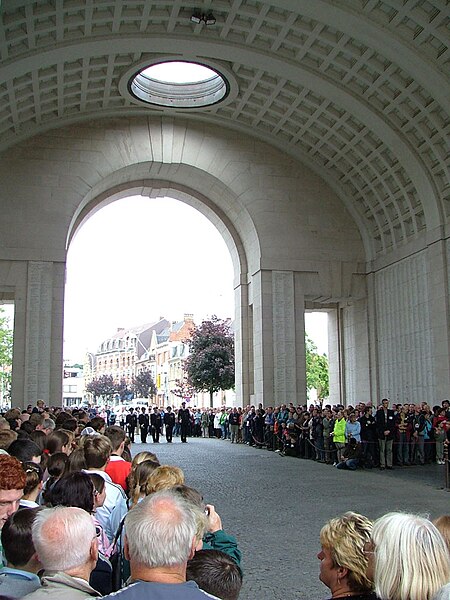
On Passing The New Menin Gate, by Siegfried Sassoon (1927)

Who will remember, passing through this Gate,
the unheroic dead who fed the guns?
Who shall absolve the foulness of their fate,-
Those doomed, conscripted, unvictorious ones?

    Crudely renewed, the Salient holds its own.
    Paid are its dim defenders by this pomp;
    Paid, with a pile of peace-complacent stone,
    The armies who endured that sullen swamp.

Here was the world's worst wound. And here with pride
'Their name liveth for ever', the Gateway claims.
Was ever an immolation so belied
as these intolerably nameless names?
Well might the Dead who struggled in the slime
Rise and deride this sepulchre of crime.

Pictures from Wikipedia

LinkWithin

Related Posts Plugin for WordPress, Blogger...